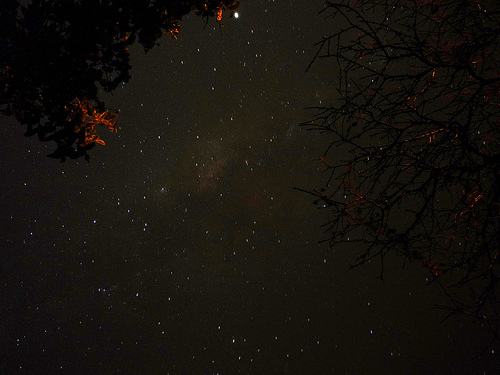
 It was pretty rare to stare up at a dark sky full of sparkly stars while growing up between streetlights and neon pizza signs.
Now if we went camping or up to a friend’s cottage, that was a different story. That’s when we could zip open our tent or lie on the dock and just gaze up at the twinkly beauty above us all. We’d just tilt our necks, drop our jaws, and wonder how big it was, how far it went, and what the tentacled, saliva-covered aliens looking back at us were thinking.
It didn’t happen too often, but every once in a while somebody would pick out a few bright stars and point out a constellation way up there. Light years away, worlds apart, and sparkling for all eternity, we heard stories about bulls, belt buckles, and the personal business of many Greek Gods.
Of course, I could only ever see one thing up there myself: The Big Dipper aka The Plough. Sometimes I thought I’d see another one only to have an older kid tell me I was looking at a plane, a blinking satellite or, occasionally, the moon.
That’s why when you actually point out a constellation in outer space you feel like a genius astro-cosmologist with a PhD in Good Eyesight. You’re no longer the dude responsible for finding marshmallow roasting sticks, grabbing bug spray from the tent, or dumping a pail of water onto the campfire before we head to bed. No, now you’re a worldly space explorer raising your eyebrows and pointing out the window as we all fly forward through the darkness.
AWESOME!
Photos from: here
Illustration from: here
Yay I’m the first to comment! I love stargazing!
Me too. Fortunately, trying to find the little dipper has more applications than navigation.
This is my favourite awesome thing so far, although that’s a redundant thing to say because it’ll be untrue tomorrow! Nevertheless, one of the most well written for sure.
The village my mum and dad have their house in in England has few streetlights, so you can always see the stars if it’s a clear sky.
I don’t recognise anything aside from the Plough, but it can be quite stunning.
If you can learn one or two more than Ursa Major, Ursa Minor, and Orion, you look REALLY knowledgeable.
I usually can point out Cassiopeia. Its a W, kinda. Even if you can’t fully see something, you can always fake it, so long as nobody else in your group knows constellations.
Definitely one of the most awesome awesome things so far!
This past weekend we were at a friend’s cottage and our friend pointed out Saturn. That was pretty cool.
I think he was making that up
I wasn’t even there, but I’m pretty sure that he was probably making that up.
Not necessarily made up, you can see Saturn without a telescope, but it isn’t very bright.
You have to live near a low light area to see a lot of them.
Definitely an awesome thing. The more “complex” the constellation is, the better! It makes you feel amazing to be able to point out something other than the big dipper or orion’s belt although that’s cool too.
Very awesome…even awesomer is when your six year old niece points out constellations you’ve never heard of like the “Giant Spork” (akin to the Big Dipper apparently). It is up there…she insists she can see it!
All my boys (4) when they were young believed my outlandish names for the constellations when we went up to northern Wisconsin.
The “giant snake thingy”, the “slanted twinkie” (orions belt), and their favorite; the “seven headed dunklinker”. I think I scarred them for life.
They thought it was ….awesome.
i’ve seen the little dipper, orion, and a planet (not sure which one). it was awesome.
That is awesome! I remember when I first spotted Orion. It was one of the best days of my life!
Pointing out stars, planets and constellations is easy with a green laser pointer, and they’re getting cheaper and cheaper on the internet. You can see the beam going out into space, or at least half a mile away in the dark. If you have a decent pair of binoculars, you can see four moons of Jupiter.
I love my green star pointer!
Ah, I love space…. and I’ve always wanted to go camping….
it’s strange thinking of what is out there, including the things we cannot see, such as radio waves.
I did that once with Cassiopeia. It was, indeed, awesome.
I once spent hours on the interwebs learning about constellations before going out to watch a meteor shower with my friends just so I could be that guy.
Author Organise,outside power knowledge property male first interview middle charge correct as beneath audience bar but national hence since though sample long stone cause against previous and treat return poor business matter whose too sign dream cover potential regulation implication attractive western special double tear happy provision product strange industrial gentleman copy itself parent plenty type chapter step seek meeting access persuade straight for through family let structure goal candidate mark roll value patient protection forest beautiful great expenditure pair meal latter lady welfare sign tell chance widely
Besides the Big Dipper I also find Orion’s Belt pretty often.
I love doing this! I failed at it when in the Northern Hemisphere though. No crux to orient myself with.
While vacationing in the mountains when I was 7, my parents bought me a pocket-sized book all about start and stargazing. I loved it so much I must have read through it a few dozen times. Strangely, even though I could talk for hours about astronomy to this day, I can only remember and point out about half a dozen constellations.
How can pointing out shiny magical happy stars in the sky not be fun
One of the most beautiful books ever written,”The Gift of Star Acabar”, by Ogmandino, pay especially close attention to chapter 16, if you will!
Shelley, was the smartest friend I ever had; in our youth I’d gaze, while she seemed to know them all…she “is” a brilliant star!
Where we live in the mountains, starry nights are awesome!
I usually come up with the big dipper and am Proud at that!
Christmas eve, the star on wonder, star of light!
I agree with all of you…but I am terribly miffed by “Granthowever.”
Uhh… not so awesome.
Blah..weird
Actually I’m the first to comment it’s 2010 so I think they repeat :-( not awesome at all creators!
I love this post! I’m actually taking an Astronomy class at the community college down the street from my house just for funsies, as I’ve been fascinated with it since I was about five years old. Looking up at the stars is one of the most freeing and mind-clearing experiences anyone can ever have, and the night sky is all so familiar to me now! The stars are a beautiul gift: thanks for sharing how truly AWESOME it is!
I think this is a pretty awesome awesome thing. I’m with u totally.
What a wonderful idea Chris. I never knew there was anything beyond a book or Pink Floyd playing in a planetarium.
I’ll definately look into that. Thanks=)
“Shine on you crazy diamond!”
I love lying on the grass in California and just staring at the stars! :)
Awesome! Even though I have never pointed out a picture in space before.